
Let me be honest with you — most governments are nowhere close to keeping up with AI. By the time a regulation gets drafted, reviewed, consulted on, and passed, the technology it was meant to address has already moved three steps ahead. That’s not a criticism. It’s just the reality of how fast things are moving right now.
But here’s what I think most people are missing: the question isn’t really whether regulation will catch up. It will. The real question is what that world looks like — and whether your organisation is ready for it.
The “Trust Us” Era Is Ending
For years, the default approach was self-regulation. Companies published ethical AI principles, created internal review boards, and pointed to voluntary commitments as evidence of responsible behaviour. And honestly? That worked well enough when AI was mostly a behind-the-scenes tool.
That’s no longer the case. AI is now making decisions — or heavily influencing them — in healthcare, financial services, hiring, education, and government. When a system is deciding whether you get a loan, a job interview, or a medical referral, “we’ve got principles for that” is not a sufficient answer.
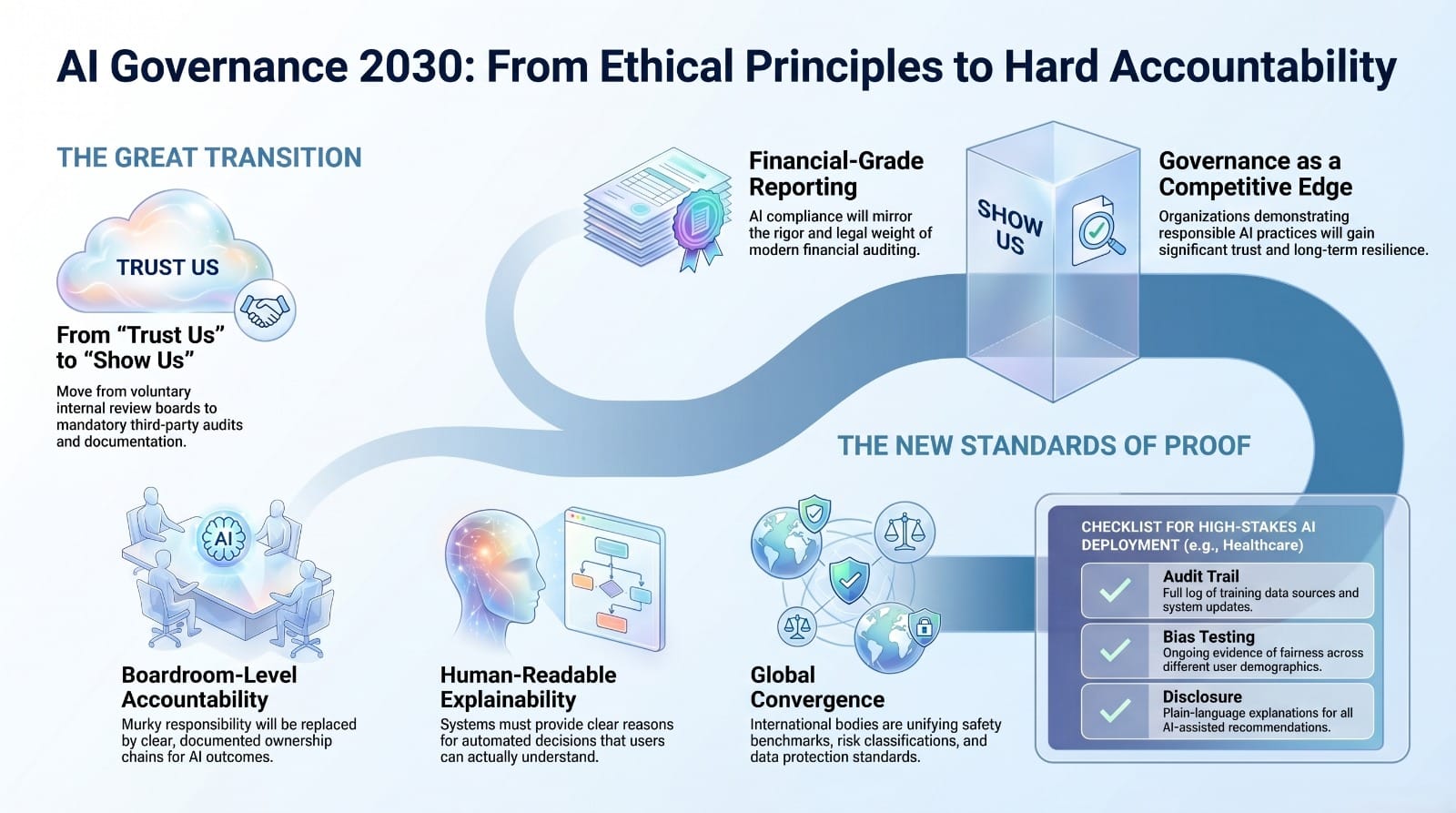
Governments are starting to act accordingly. What’s coming looks a lot more like financial auditing than a code of ethics.
- Mandatory documentation.
- Third-party audits.
- Transparency requirements you have to actually prove, not just assert.
Who’s Responsible When Something Goes Wrong?
This is the question nobody has fully answered yet — and by 2030, it won’t be optional anymore.
If an AI system produces a discriminatory outcome, who owns that?
- The company that built the model?
- The business that deployed it?
- The team that curated the training data?
Right now, it’s murky. In a few years, regulators will expect a clear answer, and “it’s complicated” won’t hold up.
Accountability chains — documented, auditable, boardroom-level accountability chains — are going to become standard practice for any organisation using AI in high-stakes contexts. This isn’t just a legal issue. It’s a leadership issue.
Transparency Has to Mean Something
There’s a real irony in how AI transparency is talked about right now. Plenty of companies claim to be transparent. Most users have no idea how the systems affecting their lives actually work.
The next phase of governance will push hard on explainability. Not just “our model uses machine learning” — but actual, human-readable explanations for automated decisions:
- Why was this application flagged?
- Why did this recommendation get made?
- What factors drove this outcome?
If you’ve ever received a rejection without any explanation, you know how frustrating it is. Regulators, customers, and employees are going to expect better than that.
A Patchwork World, Moving Toward Common Ground
Right now, if you operate across multiple countries, you’re probably navigating a patchwork of different — sometimes conflicting — AI rules. The EU has one approach, the US has another, various Asian markets have their own directions. It’s genuinely complicated.
Will we have one global AI framework by 2030? Almost certainly not. But I do think we’ll see meaningful convergence around core areas: safety benchmarks, risk classification, data protection standards, and testing requirements. International bodies are already working on this. It’s slow, but it’s moving.
For businesses operating globally, getting ahead of this fragmentation now — rather than scrambling to retrofit compliance later — is going to matter a lot.
A Real-World Illustration
Picture a hospital using AI to support clinical diagnosis. Under future governance requirements, they might need to show:
- How the model was originally trained, and on what data
- A full log of every update the system has received
- Ongoing bias testing results across different patient demographics
- Plain-language explanations for AI-assisted recommendations
- A process for reporting significant failures to health regulators
Does that sound like a lot? Maybe. But compare it to what’s already required for medical devices, clinical trials, or pharmaceutical approvals. The idea that AI systems influencing patient care should face less scrutiny than those things was never going to last.
Governance as a Competitive Edge
Here’s something worth sitting with: organisations that treat governance as a burden are going to fall behind those that treat it as a strategic asset.
People are increasingly paying attention to how their data is used, how automated systems affect their lives, and whether the companies they deal with are being straight with them. That awareness is only going to grow. The organisations that can credibly demonstrate responsible AI practices — not just claim them — will have a genuine edge in trust, reputation, and long-term resilience.
The Bottom Line
We’re heading toward a world where AI compliance looks more like financial reporting than a values statement. Accountability will be legally expected, not just ethically aspirational. Explainability will be demanded by users and regulators alike. And global standards, while imperfect, will gradually reduce the complexity of operating across borders.
The businesses that start building these foundations now — documentation, audit trails, clear accountability structures, real transparency — won’t just be ahead of the regulations. They’ll be ahead of their competitors.