
The Day I Was Fooled by Warren Buffett
I spent ten minutes watching Warren Buffett’s latest results before I realized something strange:
He didn’t say a single word.
I was watching a YouTube clip that looked like it was from the Berkshire Hathaway annual meeting.
The voice was familiar — the rough tone, the calm from the Midwest, the way he explained compound interest.
But halfway through, it felt… off.
The lip-sync was slightly out of sync.
The eyes didn’t blink the right way.
It was a 100% AI-generated deepfake.
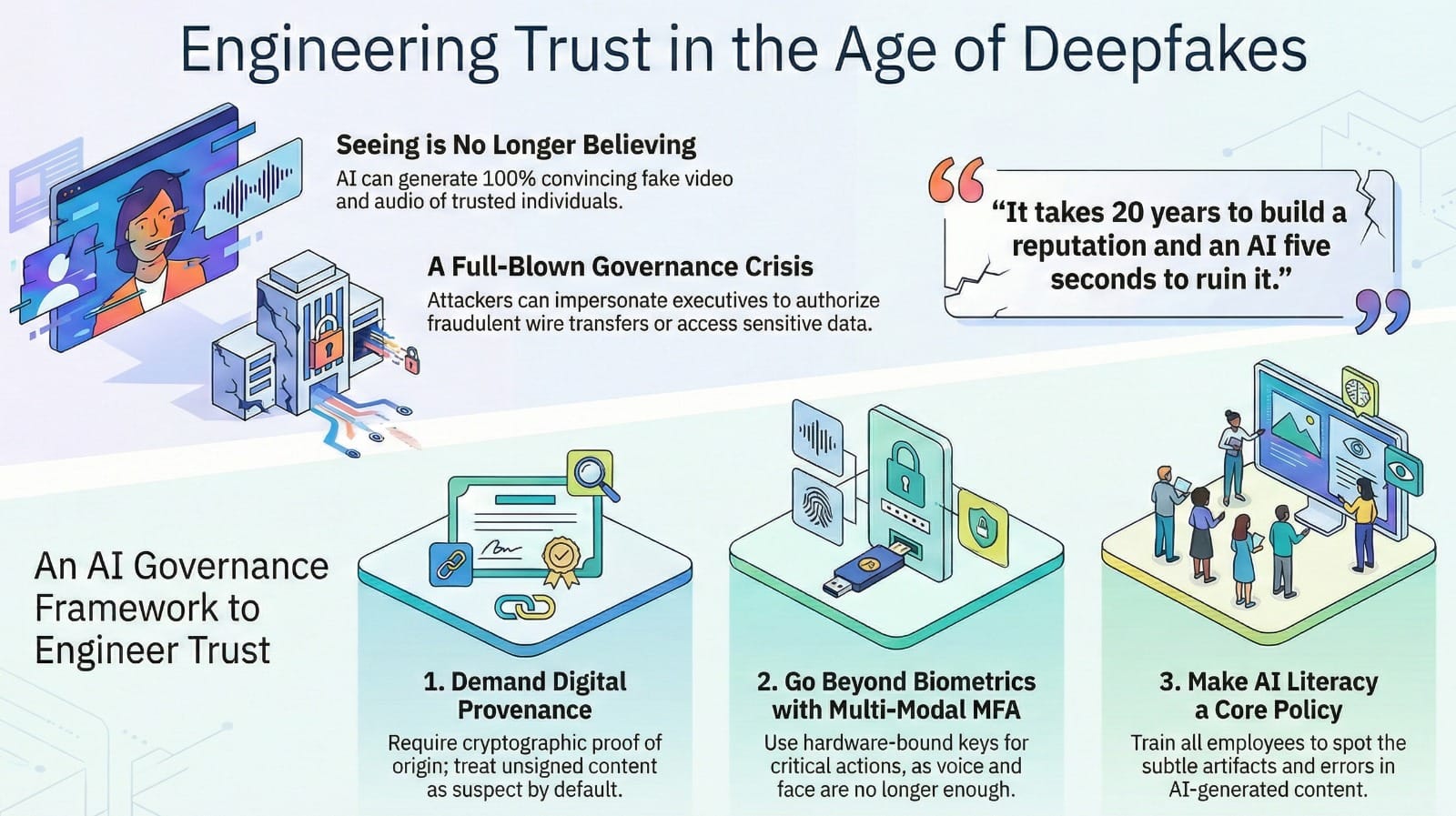
We’ve officially entered the era where seeing is no longer believing.
For businesses and governments, this isn’t just a “fake news” problem.
It’s a full-blown Identity and Access Management (IAM) and governance crisis.
If an attacker can convince a CEO’s face and voice on a Teams call to approve a $5 million wire transfer, then your firewall doesn’t matter.
Your so-called human firewall just became the weakest link.
Why this is an AI Governance issue (not an AI ban issue)
This is why AI Governance becomes non-negotiable in 2026.
Not to stop AI — but to control trust.
1. Digital Provenance
We need cryptographic proof of origin. If content isn’t signed at the source, it should be treated as suspect by default.
2. Multi-Modal MFA (Beyond Biometrics)
Voice and face alone are no longer enough for high-risk actions. Hardware-bound authorization (like security keys) must be used for critical approvals.
3. AI Literacy as Policy
Employees must be trained to spot AI artifacts — like subtle timing errors, unnatural eye movement, or contextual slips — as part of standard security onboarding.
Warren Buffett once said:
“It takes 20 years to build a reputation and five minutes to ruin it.”
In 2026, an AI can ruin it in five seconds. Trust is no longer implicit. It must be engineered.