
Introduction
The advent of advanced artificial intelligence (AI) models is rapidly reshaping the cybersecurity landscape. Among the most discussed developments are Anthropic’s Claude Mythos and its accompanying Project Glasswing. These initiatives promise a paradigm shift in how we approach software security, moving from reactive defense to proactive vulnerability discovery. However, their emergence also brings forth complex questions for Identity Governance and Administration (IGA) architects, particularly concerning the governance of AI agents, the implications of dual-use technology, and the geopolitical ramifications of such powerful tools.
What is Anthropic Mythos?
Anthropic Mythos is a frontier AI model developed by Anthropic, distinguished by its advanced capabilities in reasoning, planning, and execution within the cybersecurity domain. It has demonstrated an unprecedented ability to identify and exploit software vulnerabilities, reportedly outperforming human experts. A notable instance involved an engineer with no prior security training leveraging Mythos to uncover remote code execution (RCE) bugs overnight . Due to its potent capabilities, Anthropic has deemed Mythos
“too dangerous to release publicly,” severely restricting access to mitigate the risk of it being used for malicious purposes .
What is Project Glasswing?
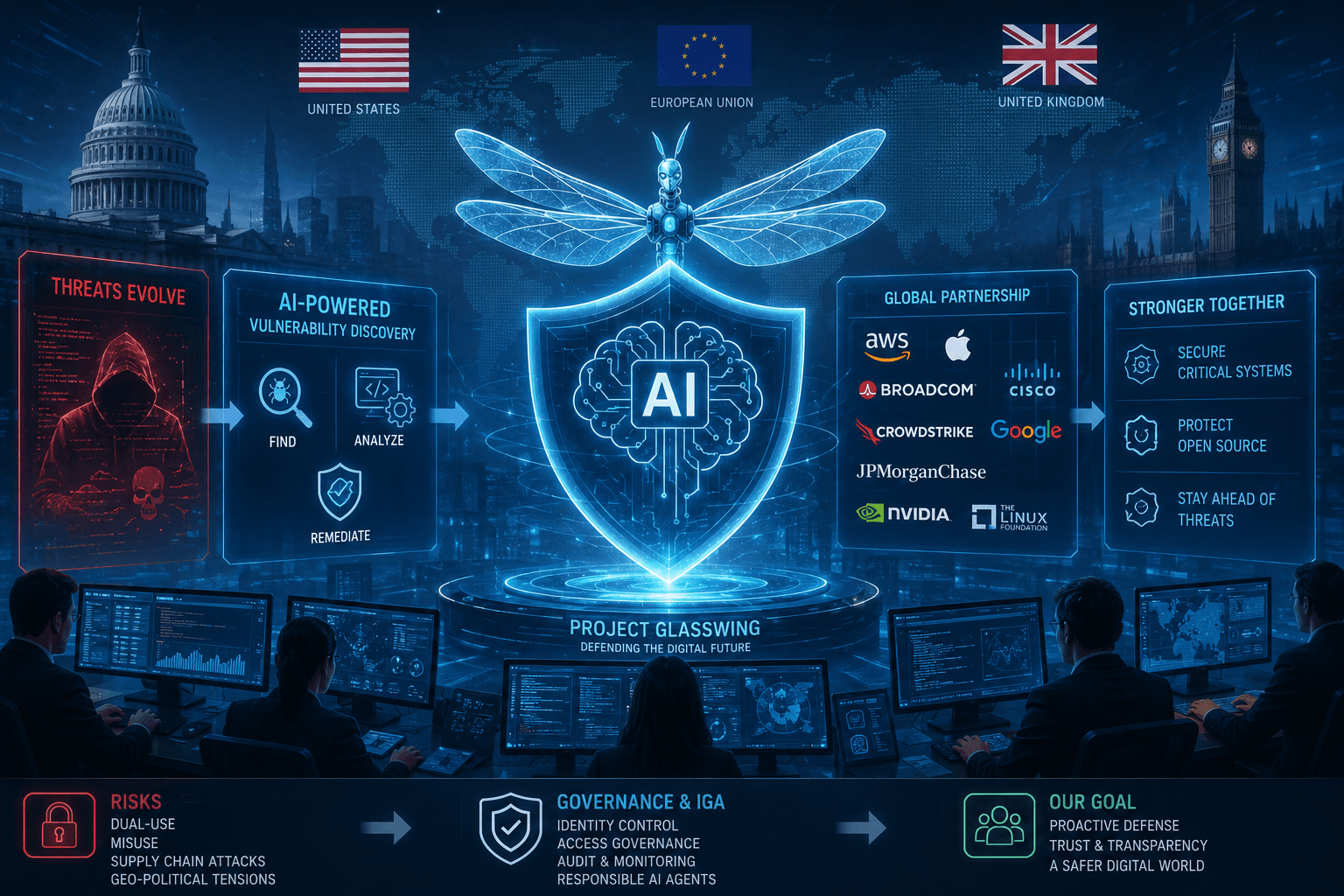
To harness the defensive potential of Mythos while controlling its risks, Anthropic launched Project Glasswing on April 7, 2026. This initiative aims to secure critical software and infrastructure for the AI era. It brings together a coalition of major technology and security organizations, including Amazon Web Services (AWS), Apple, Broadcom, Cisco, CrowdStrike, Google, JPMorgan Chase, NVIDIA, and the Linux Foundation .
Through Project Glasswing, these partners are granted restricted access to the Claude Mythos Preview model. The objective is to proactively find and remediate vulnerabilities in critical systems and open-source software before threat actors can exploit them. Anthropic has reportedly committed $100 million in credits to support this defensive coalition .
Government Initiatives and Geopolitical Tensions
The introduction of Mythos and Project Glasswing has triggered significant reactions from governments worldwide, highlighting the strategic importance of AI in national security.
United States
In the United States, Anthropic has engaged closely with federal agencies. The company briefed senior officials at the Cybersecurity and Infrastructure Security Agency (CISA) and the National Institute of Standards and Technology (NIST) on the offensive and defensive capabilities of Mythos Preview . The US Intelligence Community, including the National Security Agency (NSA), is actively evaluating the model’s potential to secure code and identify network vulnerabilities. However, this also sparks an “equity conversation” regarding whether to exploit discovered vulnerabilities in adversarial networks or prioritize defending domestic infrastructure .
Furthermore, the relationship between Anthropic and the US Department of Defense (DoD) has been complex. A prior dispute over Anthropic’s refusal to allow its tools for domestic surveillance or autonomous weapons led to a “supply chain risk” designation by the DoD . Project Glasswing may serve as a strategic effort to realign with US defense priorities while maintaining ethical boundaries.
European Union
The European Union’s experience with Mythos has been markedly different. Anthropic has largely denied European regulators and the EU AI Office access to the model, reportedly due to pressure from the White House or concerns over the EU’s regulatory environment . This exclusion has alarmed EU lawmakers, who warn that the current AI Act may be ill-equipped to handle “superhacking AI” . Financial institutions, such as the Bundesbank, have also expressed concern, arguing that European banks need access to Mythos to defend against sophisticated AI-driven cyberattacks . This situation contrasts with OpenAI, which has agreed to grant the EU access to its competing cyber model .
United Kingdom
The United Kingdom has taken a proactive approach to evaluating these new capabilities. The UK’s AI Safety Institute (AISI) conducted independent evaluations of the Claude Mythos Preview, noting significant improvements in its ability to solve complex cybersecurity challenges . Additionally, the UK government issued an open letter to business leaders, urging them to prepare for AI-driven cyber threats and emphasizing the need for robust defensive strategies .
The “Hack”: A Breach of Trust
Despite the stringent controls surrounding Mythos, reports emerged around April 21, 2026, of unauthorized access to the Claude Mythos Preview model . The breach allegedly occurred through a third-party vendor environment rather than a direct compromise of Anthropic’s core infrastructure .
This incident exposed the “hack-enabling” capabilities of the model to unauthorized groups, sparking widespread concern. It underscored a critical vulnerability: even the most advanced cybersecurity tools are susceptible to supply chain attacks. The irony of a model designed to secure software being compromised via a vendor highlights the complex reality of modern cybersecurity ecosystems.
Analyzing the Hype: Is it Justified?
The hype surrounding Anthropic Mythos and Project Glasswing is driven by several factors:
1.Unprecedented Scale: The model’s ability to uncover vulnerabilities that have existed for decades across major operating systems represents a quantum leap in capability.
2.The “Forbidden Fruit” Effect: Anthropic’s decision to restrict access and label the model “too dangerous” has naturally amplified interest and speculation.
3.Geopolitical Stakes: The technology has become a focal point in the broader AI arms race, particularly concerning US-China competition and transatlantic regulatory differences.
From an IGA perspective, the hype is largely justified, but it requires a nuanced understanding of the implications.
The IGA Architect’s Verdict: Is it Worth It?
As an IGA architect, evaluating the worth of Project Glasswing involves weighing its transformative potential against the novel risks it introduces.
The Case for Investment
The primary value proposition of Mythos is its ability to shift cybersecurity from a reactive “detect-and-respond” posture to a proactive “predict-and-prevent” model. The capacity to automate the auditing of massive codebases—a task that would take human analysts years—is invaluable. For organizations managing critical infrastructure, participating in initiatives like Project Glasswing offers a crucial advantage in identifying and remediating vulnerabilities before they are exploited.
The Case for Caution
However, the deployment of such powerful AI agents introduces significant challenges for Identity Governance and Administration:
| Challenge | Description | IGA Implication |
| Agent Identity Management | AI models like Mythos act as autonomous agents capable of modifying code and infrastructure. | IGA frameworks must evolve to manage non-human identities with unprecedented levels of access and capability. Traditional Role-Based Access Control (RBAC) may be insufficient. |
| Single Point of Failure | Relying heavily on a single, highly capable model creates a concentrated risk. The recent vendor breach demonstrates this vulnerability. | Robust continuous authentication and zero-trust architectures must be applied to the AI agents themselves, ensuring their actions are constantly verified. |
| Vendor Lock-in and Geopolitics | Dependence on a tool that can be restricted by government mandates (as seen with the EU) introduces systemic risk. | Organizations must maintain diverse security portfolios and avoid over-reliance on a single vendor, especially one subject to volatile geopolitical pressures. |
Conclusion
Anthropic Mythos and Project Glasswing represent a watershed moment in cybersecurity. They offer the tantalizing prospect of securing our digital infrastructure at an unprecedented scale. However, they also demand a fundamental rethinking of how we govern access and manage identities. For IGA professionals, the challenge is no longer just managing human access; it is designing frameworks robust enough to govern the highly capable AI agents that will increasingly defend—and potentially threaten—our networks. The investment is worth it, but only if accompanied by a rigorous, modernized approach to identity governance.