Everyone talks about the upside of AI.
It helps teams move faster, automate repetitive work, reduce costs, and launch products that would have required much larger teams just a few years ago. That’s why startups everywhere are rushing to integrate AI into their products and internal operations.
What gets less attention are the risks.
Not the science-fiction scenarios. Not robots taking over the world. The practical business risks that can hurt a company long before it reaches scale.
I’ve noticed that many founders focus heavily on what AI can do and spend far less time asking what could go wrong. That imbalance can become expensive.
Here are ten risks worth paying attention to before AI becomes deeply embedded in your business.
1. Privacy Problems Can Appear Faster Than Expected
The moment customer data enters an AI workflow, you’re dealing with privacy obligations.
Many founders assume that because they already have access to customer data, they can freely use it to train models or improve AI systems. In reality, regulations are becoming stricter across the world, and regulators are paying attention.
A shortcut that saves a few weeks of development today could create legal headaches later. Building proper consent mechanisms and data governance processes isn’t exciting work, but it is often the difference between a scalable company and a future compliance problem.
2. AI Learns From Human Bias
AI doesn’t magically become objective.
It learns from existing data, and existing data usually contains historical biases, inconsistencies, and blind spots.
A hiring model may unintentionally favor certain candidates. A lending system might disadvantage specific groups. Even recommendation engines can produce outcomes that reinforce existing inequalities.
The difficult part is that these issues are not always obvious at first. Sometimes they only become visible after thousands of decisions have already been made.
3. Copyright Questions Are Far From Settled
Many companies are using AI-generated text, images, code, and marketing content without fully understanding the legal landscape.
The problem is simple: ownership rules are still evolving.
If a model was trained on copyrighted material, or if generated content closely resembles protected work, disputes can arise. Most startups don’t think about this during the early stages because growth feels more urgent than legal risk.
That can be a costly assumption.
4. Teams Start Trusting AI Too Much
One pattern I’ve seen repeatedly is that people stop questioning AI once it proves useful.
At first, employees verify every response. Then confidence grows. Eventually, outputs are accepted without much scrutiny.
That’s when mistakes become dangerous.
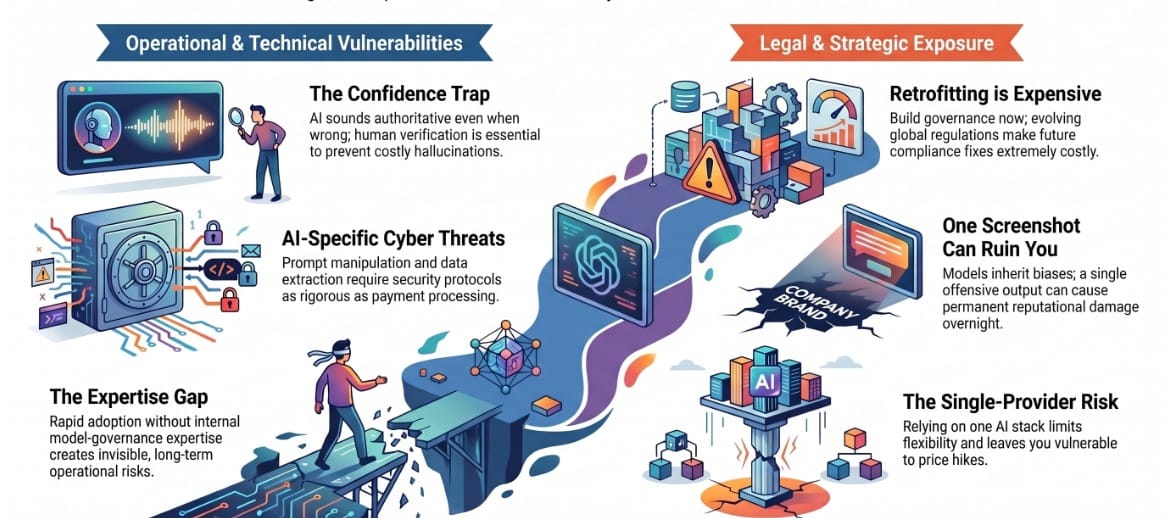
AI can produce answers that sound intelligent and professional while being completely wrong. When nobody checks the output, small errors can quietly spread through customer communications, internal reports, and business decisions.
5. AI Creates New Security Challenges
Most founders already think about cybersecurity.
What many don’t realize is that AI introduces entirely new attack surfaces.
Attackers are experimenting with prompt manipulation, data extraction techniques, and other methods designed specifically for AI systems. If an AI assistant has access to internal company information, the potential damage from misuse increases significantly.
Treat AI security with the same seriousness as payment security.
6. Regulations Are Moving Faster Than Many Companies
A few years ago, AI regulation was mostly theoretical.
Today, governments around the world are actively creating frameworks and compliance requirements. The rules will continue changing as the technology evolves.
The companies that build compliance into their systems early will have a much easier time adapting than those forced to redesign everything later.
Retrofitting compliance is rarely cheap.
7. Hallucinations Remain a Major Problem
This is probably the risk I see underestimated most often.
AI systems are incredibly good at sounding confident. Unfortunately, confidence and accuracy are not the same thing.
A chatbot can invent facts. An AI assistant can create fake citations. A content generator can present incorrect information as if it were verified truth.
In low-risk situations, this is inconvenient.
In legal, medical, or financial contexts, it can become a serious liability.
8. Depending on One AI Provider Can Backfire
Many startups build their entire AI stack around a single provider.
It feels logical in the beginning. Development is simpler and implementation is faster.
But what happens if pricing changes dramatically? What if performance drops? What if a critical service experiences outages?
Businesses that depend entirely on one provider often discover that switching later is far harder than expected.
Flexibility is not wasted effort. It’s insurance.
9. Reputation Can Be Damaged Overnight
Technology problems can often be fixed.
Reputation problems are harder.
One screenshot showing an AI system making an offensive statement, generating misleading information, or treating customers unfairly can spread across social media within hours.
People rarely remember the technical explanation afterward. They remember the headline.
For consumer-facing companies especially, reputational risk deserves as much attention as technical performance.
10. Most Companies Lack AI Expertise
AI adoption is moving faster than AI education.
Many businesses have people using AI every day but very few people who truly understand how models behave under pressure, how they fail, or how to govern them responsibly.
That knowledge gap creates risks across operations, compliance, security, and product development.
Founders don’t necessarily need a large AI team from day one, but they do need access to people who understand the technology beyond the marketing hype.
Final Thoughts
AI is neither a miracle nor a threat on its own.
It’s a powerful tool.
Like any powerful tool, it can create tremendous value when used thoughtfully and significant problems when deployed carelessly.
The founders who succeed over the next decade won’t be the ones who avoid AI. They’ll be the ones who understand both its strengths and its weaknesses.
Moving fast still matters.
Just make sure you’re paying attention to what might be waiting around the corner.